
Low Current, Low Noise Probing
PROBING FEMTOAMPS AT HIGH TEMPERATURE
WITH SIGNATONE TRI-TEMP HARDWARE
INTRODUCTION
Measuring leakage currents on semiconductor wafers and within devices has
always been a challenge for analytical probing equipment, as well as the
supporting instrumentation. With market demands for higher density ICs, lower
power, improved reliability, and features like programmability, semiconductor
makers engineer processes to push leakages and device "off currents" ever
lower. When these currents are less than a picoamp, direct measurement can be
very difficult. Though large cross-section process control structures can
"scale up" some currents, space limitations and/or special requirements (e.g.
failure analysis and spot defect investigations) often render this technique
impractical. An alternative method, "magnifying" leakage via high
temperatures, demands good temperature control and a low noise environment.
Until recently, probing currents in the femtoamp range required special
equipment and expertise. Often, valuable data simply was not collected.
Enhanced instruments, such as the Hewlett Packard 4156A semiconductor
parameter analyzer, attack part of this problem. But to be fully useful for
analytical probing, probing equipment enhancements are also needed.
Specifically, triaxial shielding techniques (e.g. separate force-sense,
driven guard and shield paths) employed within the HP 4156A must be extended
to the probe station's wafer test area. Parts of this extension must
withstand "hot chuck" temperatures to enable testing at high temperatures.
Signatone Corporation now offers two products, the TRX Probe and Tri-Temp Hot
Chuck, which address these needs. Combined with other Signatone products,
such as the QuieTemp temperature controller, probe stations, manipulators and
a dark box, a complete solution to low current probing requirements is now
available. This application note describes results achieved with these
products, which show little or no degradation in measurement capability up to
chuck temperatures of 300oC. Descriptions of equipment employed, as well as
setup and application tips, are included to aid in obtaining good results,
quickly and easily. This information should help bring the full capabilities
of these new products to bear on your analytical probing tasks.
RESULTS
Three sets of tests demonstrate the low noise and leakage characteristics of
the TRX Probe and Tri-Temp Hot Chuck: First, the leakage and noise
contribution of the TRX Probe are demonstrated. Next, the noise and
equivalent resistance of the Tri-Temp Hot Chuck are measured. Last, to show a
typical application, sweeps of an N-MOS transistor drain current, from
subthreshold through saturation, were repeated between 20oC and 300oC. Tests
were performed employing the practices outlined under "Setup Tips" below. Of
greatest importance were proper use of the dark box, implementation of solid,
low impedance electrical connections, and compliance with the HP 4156A
recommended operating procedures.
First, the four high resolution source-measure units (HRSMU's) of the HP 4156A
were connected to the source, drain, gate and substrate pads of a transistor
on the test wafer. After confirming all connections via a sweep, the drain
probe tip was lift ed, just breaking contact with the wafer, and the gate
voltage was swept again. TRX Probe noise and leakage, at room temperature and
250oC, appear in Figures 1 and 2. This represents the combined noise of the
probe, setup and parameter analyzer. The total magnitude approximates +1 fA
at both temperatures, at or below the 1 fA resolution limit of the analyzer.
Both tests were made with QuieTemp controller power on, after temperature
stability was achieved. Per recommended procedures, sweeps were performed
after an "offset cancellation" (instrument zero reset) and completed quickly
to minimize drift. (As described later, long sweep times can result in
greater drift and noise, but in all cases the noise and leakage contribution
of the TRX Probe remained negligible.)
The wafer back side often provides an essential connection which must be
biased and shielded from noise to achieve meaningful results. At other times,
measurement of current flowing from the backside (e.g. substrate current) is
needed. The Tri-Temp Hot Chuck accommodates both needs by providing a
triaxially isolated and shielded wafer platen, while also resolving the
thermal conductivity, thermal expansion and mechanical stability issues. To
evaluate the Tri-Temp Hot Chuck, substrate-to-ground noise and leakage of a
wafer were measured as the substrate was swept from - 40 to +40 volts and
back. As before, measurements were made with the thermal chuck power on.
Results at 20oC (Figure 3) show peak "noise" currents near 20 fA, with average
noise below 10 fA. (These small currents are thought due to relatively larger
"driven guard" loading effects in the Tri-Temp Hot Chuck, and low level noise
emanating from the nearby heating element.) Results of a similar -40 to +40
volt sweep, performed at 300oC, appear in Figure 4. Peak-to-peak noise
remained about the same, but a minor resistive leakage is observed. This
sub-80 fA change for a voltage change of 80 volts, shows the equivalent chuck-
to-ground resistance exceeds 1015 ohms (i.e. > 1000 TW !), defining the Tri-
Temp Hot Chuck as a "best of class" product.
Last, TRX Probes were connected to transistor source, drain, gate and
substrate pads, with the substrate probe guard also connected to the Tri-Temp
Hot Chuck guard terminal. Channel length and width of this N-MOS device were
1.0 m and 50 m respectively. A -0.5 volt substrate bias assured that a
resident protection device (between gate and substrate) would not interfere
with subthreshold measurements. With the drain-to-source voltage programmed
to 0.2 volts, the gate voltage was swept from -0.5 to 1.5 volts. Resulting
drain current plots, at wafer chuck temperatures of 20oC, 50oC, 100oC, 150oC,
200oC, 250oC and 300oC, appear in Figure 5. Note the measured 1-3 fA off
currents at 20oC are "as predicted" by semilog extrapolation of 50-150oC off
currents! Though some measured currents are below the specified +20 fA
accuracy limits of the analyzer, this data further reveals the low noise and
leakage capabilities of the TRX Probe and Tri-Temp Hot Chuck, and their
ability to facilitate ultra-low current measurements across a wide temperature
range.
EQUIPMENT
The essentials for making "on wafer" femtoamp current measurements are first,
an instrument capable of resolving low currents, and second, methods of
maintaining a low noise environment up to and surrounding the wafer chuck.
Last, noting it would take 100 seconds for 10 femtoamps to charge 1 pF through
1 volt, we see capacitances cannot be ignored. To achieve tolerable
measurement times, triaxial "driven guard" methodologies must be employed to
nullify the effects of interconnect and device capacitances. The equipment
describes below provides all elements of this recipe.
Probe Station, Dark Box & QuieTemp Controller
A solid environment for low current probing was provided by mounting a
Signatone S1160 probe station and manipulators, in a metal dark box. This box
shields the wafer from ambient light, which dramatically alters leakages. It
also extends the electrical "shield" to entirely enclosed the test site.
Proper use of dark box is essential for accurate, repeatable results. TRX
Probes were mounted to standard manipulators, with their cables connected to
the internal side of triaxial bulkhead connectors, mounted through the wall of
the dark box. The Tri-Temp Hot Chuck was mounted atop the probe stations X-Y
table, with all cabling and cooling tubes routed through a rear service port
to an external QuieTemp temperature controller and recirculating chiller.
The Parameter Analyzer
Fixturing and other setup extensions rarely enhance, but often degrade,
measurement accuracy, repeatability and noise. Using a high quality
instrument is recommended, as results must always be interpreted in the
context of the instrument's limitations. These evaluations were made using
the HP 4156A parameter analyzer. This versatile tool is similar to its
predecessor, the HP 4145, but it boasts extended capabilities. Key to these
evaluations were the new low current capabilities, including a 10 pA
measurement range, with 1 fA resolution and +20 fA accuracy
specifications. Recommended operating procedures, including appropriate hold
and delay time settings, integration periods, and frequent "offset
cancellation" were used to maximize performance. Via repeating and cross-
checking measurements, the analyzer was observed to stay well within these
specifications. The analyzer's rear mounted HRSMU connectors were connected
to the external side of the dark box "through wall" connectors via
manufacturer supplied triaxial cables.
TRX Probe & Tri-Temp Hot Chuck
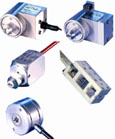
Signatone's TRX Probe and Tri-Temp Hot Chuck were developed to address the
challenges of low current, high temperature probing. Incorporating low noise,
triaxial techniques throughout, TRX Probes mate with conventional BNC style
triaxial connectors, and are easily mounted to several models of Signatone
manipulators. Probe tips are replaceable for easy maintenance and to permit
tailored tip geometries for specific needs. Materials have been selected for
their low noise and high temperature characteristics, providing compatibility
with chuck temperatures to 300oC. The Tri-Temp Hot Chuck also incorporates
low noise, high temperature materials. The design incorporates an isolated
wafer platen, with underlying "driven guard" and "shield" layers, a full
implementation of triaxial methodology. In use, the wafer platen is
connectedto the source-measure terminal of one HRSMU, while the Tri-Temp Hot
Chuck "guard" is tied to the driven guard of the same HRSMU. The Tri-Temp Hot
Chuck "shield" is grounded to the dark box frame, connecting it to the HRSMU
shield via the "through wall" connectors.
Setup & Measurement Tips
Though low current measurements can now be relatively straight forward,
applying several of the precautions and techniques below can speed the
process. When currents are very small, long settling times and extensive
measurement averaging are necessary. Since analyzer sweeps can take
minutes each, getting correct results "the first time" saves a lot of time.
Three groups of "tips", addressing equipment setup, use of the HP 4156A, and a
few device issues, appear below.
Basic Setup Issues:
- Eliminate all light from the dark box; even dim light increases leakage by
orders of magnitude!
- Inspect the box and seal all light leaks.
- Employ tape over metal foil to block both light and electrical noise.
- Fully close the door, engaging the light locks, for each measurement.
- Make sure microscope lights are fully off.
- Assure no light leaks in via the fiber optic "light pipes" of an external
light source
- Provide good, low impedance grounds; even millivolts of ground noise will
degrade results:
- Pick one point (e.g. a "through wall" connector lug) as a ground Mecca;
avoid ground loops.
- Check all grounds with a meter; impedances should be a few hundred
milliohms or less.
- Reduce or eliminate "noise" sources inside the dark box:
- Use grounded shielding around hot chuck power cables and thermocouples
exiting the box.
- Remove or shield insulator sleeves which could generate or store static
electricity.
- Avoid rubbing or bending cables or insulators which could induce static
charge.
- Test after the chuck temperature has stabilized; this minimizes heating
element noise.
- Periodically clean the chuck with alcohol; contamination can introduce
unstable leakages.
Using the HP 4156A:
The HP 4156A is a sophisticated digital instrument, featuring periodic auto
calibration, as well as built-in filtering and integration techniques
Several recommendations for making ultra-low current measurements are found i
the users manuals. Key points from the manuals, and a few lessons learne
while performing the above tests are reiterated below:
Providing the recommended environmental conditions (23oC + 5oC temperature and
5-60% relative humidity) and 40 minute plus warm up period minimizes drift.
To achieve 1 fA resolution, set the HRSMU to "auto-range" or "fixed" on the 10
pA range.
Set the integration period to "long" to average out noise and maximize
accuracy.
Increase "hold" and "delay" times until sweeping in both directions achieves
similar results. Hysteresis in "double sweeps" usually implied times were too
short. The above N-MOS drain current sweeps were achieved with a 1 second
hold and 0.2 second delay times. High voltage sweeps of the Tri-Temp Hot
Chuck employed 15 second hold and 1 second delay times.
Perform a "cancellation offset" directly before each low current measurement.
Temporarily lift the probe tip to null out residual device leakages. Note,
under the specified conditions, this assures the specified +20 fA accuracy,
but not that ever femtoamp resolved in the prior sweep will be nulled.
By experimentation, find minimum delay and hold times needed for good results.
Use these settings to minimize measurement time, thereby reducing the
opportunity for instrument drift. To illustrate, compare the sweeps of Figure
1 with Figure 6 below. Settings were similar except that the latter plot
contains 12 times as many steps. The resultant 6 minute (vs. 30 second)
sweep time reveals the additional drift and noise encountered as execution
time increases. (Note, in both cases the HP 4156A was well within its spec.)
Some Device Issues:
If results are inconsistent, be aware device or wafer level issues may be the
root cause:
To evaluate dual well CMOS, control both well potentials to avoid small
currents which can flow as floating structures charge and discharge.
Bias active (amplifying) devices to keep gains low, minimizing the
possibilities of oscillation. Note analyzer filtering and integration
(averaging) functions could easily mask this condition.
Over stressed or ESD damaged devices can exhibit unstable leakages; again
filtering and integration could also mask this problem.
|